The Complete Guide to Browser Games in 2026: Technology, Strategy, and the Future
Everything you need to know about browser gaming — how it works, why it matters, and how to get better at the most popular titles.
Published May 3, 2026 · By Shivam Kumar · 9 min read · Guides
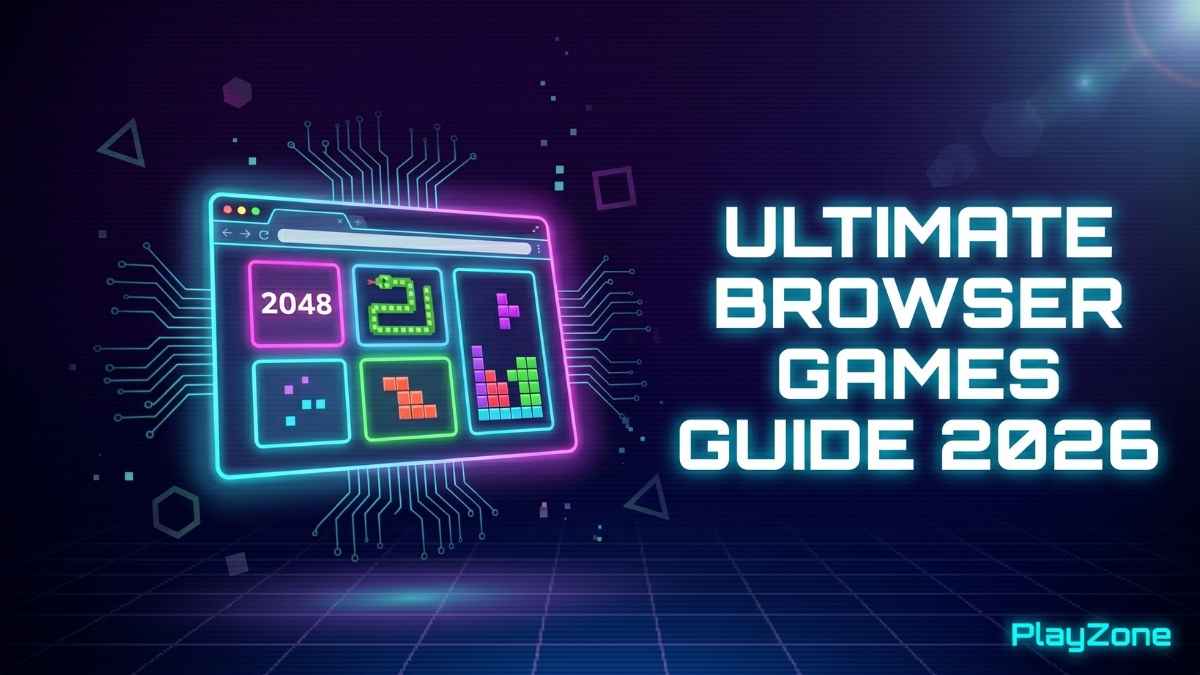
Browser games have undergone a complete transformation in the past decade. What began as simple Java applets in the 1990s evolved into the Flash-powered era of the 2000s, and by 2020 the entire ecosystem had migrated to HTML5 — a standard so capable that many of today's browser games are indistinguishable from downloaded mobile apps. This guide covers everything you need to know about browser gaming in 2026: the technology behind it, the genres available, the strategy that separates casual players from experts, and the practical benefits of keeping a game library bookmarked in your browser.
The Technology Behind Modern Browser Games
Modern browser games run on HTML5, a umbrella term that covers the HTML5 Canvas API for 2D rendering, WebGL for GPU-accelerated graphics, and WebAssembly for near-native performance. Together these technologies allow developers to build games that rival mobile app quality without requiring any download or installation.
The key advantage of HTML5 over its predecessors is universality. A single HTML5 game runs identically on Windows, macOS, Linux, Android, iOS, and even smart TVs with a browser. There is no App Store approval process, no version compatibility issues, no storage space required. You click a URL, and within one or two seconds you are playing. This simplicity is the reason browser gaming has survived every platform shift of the past twenty years.
The performance gap between browser and native has also largely closed for the types of games most people play. Casual puzzle games, arcade titles, platformers, and racing games all run at full 60fps in any modern browser. Only the most demanding 3D titles still show a meaningful gap between browser and desktop performance, and that gap is narrowing every year as WebGPU adoption grows.
Why Browser Games Are Different From Mobile Apps
The most important practical difference between browser games and mobile apps is the lack of friction. A mobile app requires you to open an app store, read reviews, tap install, wait for a download, grant permissions, and then open the app. A browser game requires you to click a link. For a five-minute game session, that difference in friction is the difference between playing and not playing.
Browser games also do not collect the same level of personal data as mobile apps. A mobile game typically requests access to your camera, microphone, contacts, and location as a condition of installation. Browser games run inside the browser sandbox and cannot access any of those system resources without your explicit permission each time. For parents letting children play, this is a meaningful safety consideration.
The sharing model is also fundamentally different. A browser game is just a URL — you can paste it in a text message, an email, a Slack channel, or a social media post, and the recipient is playing within seconds. Mobile games require you to send them to the app store, find the game, and install it before they can play. For casual social gaming — sending a friend a quick game to settle a debate, for example — the browser model is categorically faster.
The Best Genres for Browser Gaming
Not every game genre translates equally well to the browser. Puzzle and arcade games are the natural fit: short rounds, simple controls, instant restarts. Strategy games work well for similar reasons. First-person shooters and complex RPGs are technically possible in the browser but generally feel compromised compared to their native counterparts. Here is a breakdown of the genres that work best in a browser tab.
Puzzle Games
Puzzle games are the ideal browser genre because the sessions naturally fit the browser's context. You are already at your desk with a keyboard; the games are designed around keyboard or touch input; and a single round takes between three and fifteen minutes — the exact length of a coffee break. 2048, Memory Match, and Tetris all exemplify this pattern. The depth-to-simplicity ratio in great puzzle games is extraordinary: you can learn the rules in thirty seconds and spend years mastering the strategy.
Arcade and Reflex Games
Arcade games reward fast reactions and immediate feedback, and browser latency is low enough that this works perfectly. Snake, Flappy Bird, and Pong are all reflex-intensive games that run identically on desktop and mobile browsers. The common thread is simple input: arrow keys or swipes are the only control these games need, which means the technology never gets in the way of the experience.
Classic Platformers
Platformers were historically difficult to bring to the browser because precise timing is central to the experience and browser input lag made this feel wrong. Modern browsers have solved this problem — input latency on Chrome, Firefox, and Safari is now low enough that platformer timing feels correct. Platformer demonstrates how well the genre works in HTML5, with tight controls and responsive physics that feel natural on both keyboard and touch.
Racing Games
Browser racing games have surprised many players with how good they feel. The pseudo-3D rendering technique used in classic arcade racers — the same visual style behind OutRun and Road Rash — translates perfectly to HTML5 Canvas. Racer is the example on this site: it runs at 60fps, includes mobile touch controls, and captures the feel of late-80s arcade racing with accuracy that borders on nostalgic.
How to Improve at Browser Games: A Structured Approach
Most people play browser games casually — opening a tab, playing for a few minutes, closing it. But there is a meaningful difference between casual play and deliberate practice, and the difference shows up in results. Here is a framework for improving at the most popular browser game categories.
2048: The Corner Strategy
Most 2048 players swipe randomly and end up with a board that has no coherent structure. The corner strategy changes this by committing your largest tile to a single corner — typically the bottom-right — and using only two directions to build monotonic chains toward that corner. The logic is straightforward: if your largest tile never leaves its corner, you can always build toward it without destabilising your existing progress. Our full 2048 strategy guide covers this in detail with specific board positions and common mistake patterns.
Snake: The Spiral Method
Snake deaths almost always happen in the mid-game, when the snake is long enough that self-collision becomes a genuine risk. The spiral method solves this by committing to a single travel direction — clockwise or counter-clockwise — and spiralling inward from the perimeter. This guarantees that your body is always parallel to itself, which eliminates the possibility of cutting off your own head. You break the spiral only to collect food, then immediately return to it. Our Snake strategy guide covers the spiral in detail with phase-by-phase instructions for the early, mid, and late game.
Tetris: The T-Spin Setup
Most casual Tetris players focus on line clears and ignore the T-spin, the most powerful scoring technique in the game. A T-spin occurs when you lock a T-shaped tetromino into a position where it cannot be placed flat, forcing a rotation. The scoring multiplier for a T-spin is significantly higher than a standard line clear, and learning to set them up transforms your game from "survive as long as possible" to "deliberately engineer high-scoring sequences." Our Tetris T-spin guide has the opening setups and wall patterns that tournament players use.
The Cognitive Science of Casual Gaming
The popular dismissal of casual games as "just time-wasting" does not survive contact with the research. Studies consistently show that deliberate play of puzzle and arcade games produces measurable improvements in visuospatial reasoning, working memory, reaction time, and stress recovery. The catch is the word "deliberate" — aimless swiping produces no measurable benefit; playing with a specific constraint (keep the biggest tile in the corner, for example) produces significant benefit.
The research also shows that the improvements are highly specific to the skill being trained. Playing Snake does not make you better at chess. Playing 2048 does not improve your vocabulary. But within its domain, each game trains a real, measurable cognitive skill. For a more complete picture of what the research says, read our article on how casual browser games actually train your brain, which covers the peer-reviewed studies and the practical routine that translates into daily cognitive benefit.
The Business Model: Why These Games Are Free
Every game on PlayZone is free to play with no account required. This is not charity — it is a deliberate product decision based on how browser gaming is monetised in 2026. The model is advertising, specifically Google AdSense. Games run inside a standard browser environment that supports ad slots, and the revenue from those ad slots funds the servers, bandwidth, and editorial work that keeps the site running.
There are several reasons this model works better than paid games for casual gaming. First, the audience for casual games is extremely price-sensitive — most people who play a free game for five minutes will not pay to play the same five minutes. Second, the advertising revenue from a high-traffic casual gaming site is meaningful, which means the incentive is to attract as many players as possible rather than extract maximum revenue per player. Third, free games with no account requirement have dramatically higher reach than paid alternatives, which creates a healthier ecosystem for everyone.
The ads on PlayZone are placed in clearly-marked containers that are physically separate from the game area. You will never accidentally click an ad while playing — they are positioned outside the game frame and do not interfere with gameplay. See our Privacy Policy for details on how advertising personalisation works and how to opt out if you prefer non-personalised ads.
How to Build a Browser Gaming Habit That Works
The research on focus and productivity consistently shows that short mental breaks improve sustained concentration. The Pomodoro Technique — 25 minutes of focused work followed by a 5-minute break — is well-supported by evidence, and casual browser games are the ideal break activity: they are short, complete in themselves, and provide genuine mental reset without the dopamine trap of social media or news sites.
The key to using browser games productively is intentionality. Play one round, set a timer, return to work. The games that work best for this pattern are the ones with natural stopping points — 2048 has a clear win condition, Snake ends in death, Tetris ends when you top out. Unlike open-ended games that never feel finished, these games give you a natural endpoint that aligns with your break length.
Rotate between genres to keep the cognitive benefit varied. If you play 2048 every day, try Pong on days when you want social interaction, Memory Match on days when you want a gentler pace, and Flappy Bird on days when you want a pure reflex challenge. Mixing genres keeps the dopamine fresh and prevents any single game from overstaying its welcome.
The Future of Browser Gaming
Browser gaming in 2026 is healthier than it has ever been. WebGPU — the successor to WebGL — is rolling out across browsers and bringing console-quality 3D graphics to the browser. WebXR is enabling virtual reality experiences that run in a browser tab without installation. The File System Access API allows browser games to save data locally with the same capability as installed apps. Each of these technologies closes the remaining gap between browser and native, and the trajectory is clear: browser games will continue to become more capable without becoming more complex to access.
The broader trend is also favorable. As more of daily life moves to the browser — work tools, communication, media consumption — the browser tab is increasingly where people spend their computing time. A game that lives in a URL slots naturally into this workflow in a way that a downloaded app never can. The casual gaming category will continue to grow, and browser games will be the dominant form for the simple reason that friction determines behavior. A game you can play in one click will always be played more than a game that requires ten.
Related Posts
The 20 Best Free Browser Games to Play in 2026: Complete Guide
A curated guide to the best free HTML5 browser games of 2026, covering puzzle, arcade, action, and multiplayer titles with strategy tips for each.
Play 2048 Online Free — No Download Required
Play 2048 online free in your browser. No downloads, no sign-ups. Learn the corner strategy and reach 2048 consistently.
Play Free Tetris Online — No Download Required
Play free Tetris online in your browser. No downloads, no sign-ups. Complete guide with tips and strategies.