How to Beat 2048: The Complete Step-by-Step Guide
The exact strategy to reach 2048 consistently, corner technique, snake pattern, and the practice routine that works.
Published May 3, 2026 · By Shivam Kumar · 13 min read · Strategy
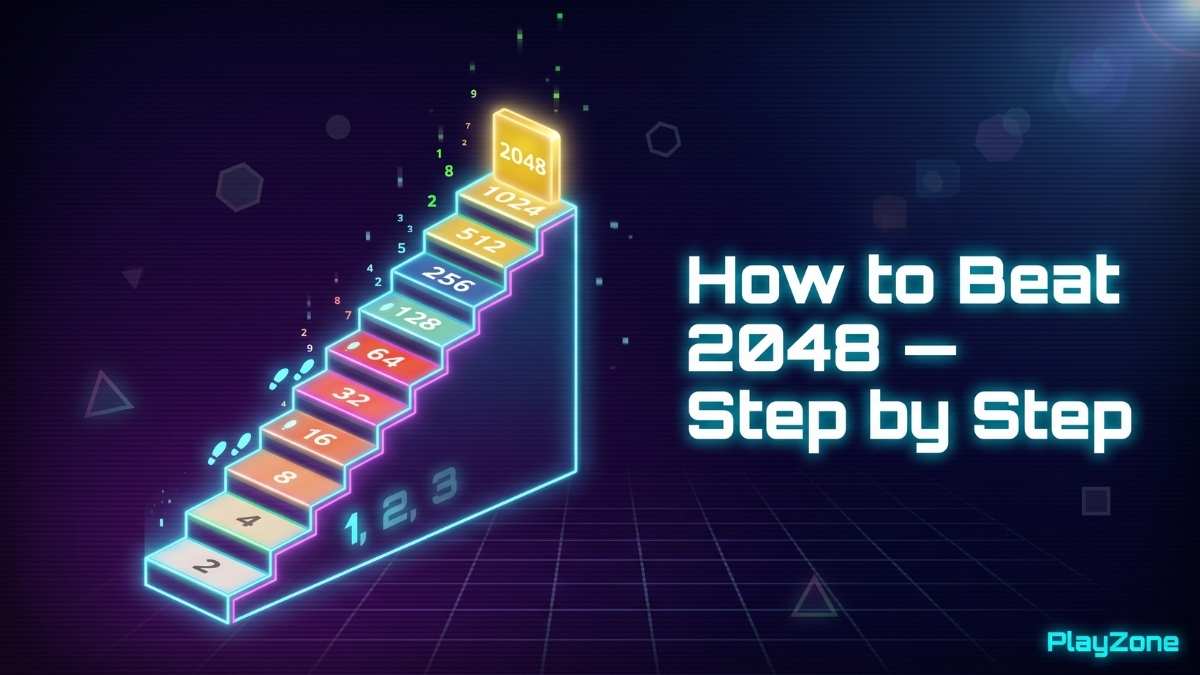
Table of contents 7 sections
2048 is Gabriele Cirulli's free sliding-tile puzzle, and you can now play 2048 right here on PlayZone for free, with no download. This is my strategy guide to a game I think is worth mastering, so open the game in another tab and try these techniques as you read. If you have ever opened 2048 for "just one quick game" and then watched an hour disappear, you know how satisfying it is to finally break through a score you have been stuck at for weeks. A lot of players hit a wall somewhere around the 512-to-1024 hump and never get past it. The good news is that the difference between a player who gets stuck there and one who reaches 2048 regularly is almost entirely about strategy, not reflexes.
This guide is for everyone stuck at that wall: hitting 512 sometimes, 1024 rarely, dying at weird moments, and wondering why some people seem to hit 2048 every other game while you've never seen the 2048 tile even exist.
The strategies here are the ones that consistently come up among strong 2048 players and the AI solvers that have studied the game. I have left out the folklore that does not hold up and kept what actually moves the needle on your scores.
Why Random Swiping Gets You Nowhere
Let me describe the most common failure mode, because if it sounds like you, this whole guide will make more sense. A lot of players start a game of 2048 and just react to the board: a 64 appeared in the top-left? Better swipe left. There's an open space on the right side? Swipe right. Oh no, the 128 is about to hit the wall? Swipe up to move it somewhere else. This feels like playing the game. It isn't. It's just watching numbers move around.
Random swiping works fine for the first five minutes of a run. The board is mostly empty, you have room to move, nothing is really going wrong. Then around the 10-minute mark, or sooner if you get unlucky with a 4 spawn, the board starts to fill. Random swiping at that point means you have four equal options, all of which have consequences you're not tracking. Usually within three to five moves, the board is unsolvable.
The alternative is to have a plan before you start playing. Not a vague "be strategic" intention, but an actual rule set you follow for every game. The corner strategy is the most reliable I've found. It's not the only approach, but it's the one that's going to take you from inconsistent scores to predictable 2048 completions.
The Corner Strategy: The Only Rule That Actually Matters
Pick a corner. Bottom-right is the conventional choice but it genuinely doesn't matter, just pick one and commit. That corner is where your biggest tile lives for the entire game. Every other tile is trying to get to it. Your job is to make sure it never leaves.
I spent way too long not doing this because it seemed arbitrary. How can the corner matter when the board is symmetric? Here's why: the corner gives you a reference point. Without one, every move is a judgment call. With one, 90% of your moves are obvious. You slide toward the corner. That's it. The other 10% of the time, you're in trouble and making actual decisions.
The two directions that move toward your corner are your primary directions. If your anchor is bottom-right, those are down and right. You use these for everything. The other two, up and left, are emergency exits only. Not alternatives, not options, not things you reach for when something else feels better. Emergency exits.
The Snake Pattern
Once your biggest tile is in the corner, you want your second-biggest right next to it, third-biggest next to that. The ideal board looks like a staircase with your largest tile at the bottom-right and each adjacent tile smaller by one step. This is the snake pattern, and if you can maintain it, 2048 almost plays itself.
Here's why it works: a new tile spawns as a 2 (90% chance) or a 4 (10% chance). If you're building along the row next to your anchor, that new tile can slide into the chain and merge upward. Instead of having to manually move each tile to its merge partner, the snake handles it. The merge happens naturally as tiles slide.
I visualise it like a funnel. Everything flows toward the corner, and when two tiles of the same value meet in the funnel, they merge and the funnel gets narrower. Eventually you're working with a board where the only tiles that matter are the ones near your anchor, and everything else is small stuff that you clear out of the way.
10 Specific Techniques That Actually Work
The corner strategy is the foundation. These are the techniques that build on it and get you from "hits 2048 sometimes" to "hits 2048 most games."
1. Never Let the Anchor Row Empty
Your anchor row, the row with your biggest tile in the corner, should never have an empty cell. This is more important than merging anything else. An empty cell in that row is where a random new tile will spawn, and if it's a 4 in the wrong position, you've broken the chain. Before you do anything else in a move, check: is my anchor row full? If not, fill it first.
2. Use Up and Left as a Warning Sign
When you feel the urge to press up or left, that's information, not an option. The urge tells you the board is getting tight in your primary directions. Instead of pressing up (which you shouldn't do), ask yourself: can I press down or right in a way that solves the problem? Usually you can. The up and left buttons are like a check engine light, they tell you something needs attention, but you don't fix it by pressing them.
3. Plan for the 4 Spawn
A new 4 appears 10% of the time instead of a 2. When a 4 spawns in the wrong place, it can disrupt a row you've been building. If you're one move away from a crowded board and a 4 just appeared, consider making the safe move, the move that preserves your anchor row, rather than the greedy move that merges two tiles now and opens up space that a 4 might fill badly.
4. Merge Small Tiles First
The smallest tiles, the 2s and 4s, are the most likely to create pockets that trap your bigger tiles. When you see two 2s adjacent, merge them. Two 4s? Merge them. This keeps the board clean and gives you more room to work. It's boring, methodical, and not exciting at all, but it works.
5. The Emergency Stack
Sometimes, often, if you play enough, you'll get a board where your anchor is genuinely threatened. The tile next to it is getting big, there's nowhere to put it, and you can feel the run slipping. The emergency technique is to take your second-biggest tile and move it down to the row above your anchor, directly adjacent to it. This is a deliberate sacrifice of a few small merges, but it buys you five or six more safe moves. Use it when you're in genuine trouble, not as a routine move.
6. Don't Rush the 2048 Merge
You're staring at two 1024s. You could merge them right now and reach 2048. Before you do, look at the board. Is there open space around both of them? Where will the 2048 tile go after you create it? If the board is crowded and you merge into a tight space, your new 2048 will have nowhere to move and you'll die on the same turn you "won." Wait for a cleaner board. The 2048 tile is worth nothing if it immediately gets stuck.
7. Keep the Board as Open as Possible
Every move should, if possible, keep at least two adjacent empty rows or columns. A completely open board is always better than a packed one. When you're choosing between a merge that opens space and a merge that consolidates everything into one corner, choose the open option. Open boards give you flexibility. Crowded boards force bad decisions.
8. Know When to Break the Pattern
Strictly following the corner strategy will get you to 2048 most of the time. But sometimes the random spawn will give you a board where the pattern simply can't continue, the tile distribution makes it geometrically impossible to maintain the snake. When you hit this state, don't keep forcing it. Make the best moves you can and accept the loss. Not every game is winnable, and the runs you lose despite near-perfect play will feel less frustrating once you accept that some boards are genuinely unwinnable.
9. The Forced Merge Setup
Set up two identical tiles with one empty cell between them. When you slide toward the gap, both tiles merge in one move, and the new spawn typically fills the gap you just created. This is a free move, you get a merge and the board stays compact. Look for these setups in the mid-game and use them whenever you see them.
10. Stop Playing After You Reach 2048
This sounds obvious but it's not. The game doesn't have a fanfare when you reach 2048, it just quietly lets you keep going. And if you're like me, you think "I'm already at 2048, let me push for 4096." The problem is that you just hit a major milestone, your focus is probably gone, and the board you have might not support continued play. If your goal was 2048, stop when you hit it. Come back tomorrow with a fresh board and a clear head.
Why the Strategy Works
I know some people want the technical explanation, so here it is in plain terms: anchoring to a corner cuts your effective choices from four directions down to about two, which roughly halves the number of ways you can go wrong on any given move. 2048 is a game of entropy management. Every move either increases or decreases the entropy of the board, the randomness and disorder in the tile distribution. Random swiping increases entropy because new tiles appear without reducing existing chaos. The corner strategy decreases entropy: each merge removes a tile and moves you up the power-of-two ladder.
When entropy is low, the board is ordered, your biggest tiles are in a chain toward the corner, the game is under control. When entropy is high, tiles are scattered, the chain is broken, the board is crowded, you're reacting to chaos and the game is increasingly out of your hands. The goal is to keep entropy low for as long as possible.
Computer science researchers have built 2048 AIs using expectimax search and deep reinforcement learning, and the game has even been studied as a formal optimization problem (see the overview on Wikipedia). The strategies these solvers discover tend to look remarkably similar to the human corner-and-snake approach, not because the AI was told to do it that way, but because that's what actually works. If you enjoy the thinking side of puzzle games, you might also like my piece on the cognitive benefits of browser games.
The Practice Routine That Actually Works
Reading about strategy and implementing it under pressure are different skills. Here's the practice routine I used to internalise the corner approach:
For your next 20 games, don't allow yourself to press up. At all. If your only option is up, restart the game. This is painful for the first five games. You will feel trapped, constrained, and like the game is cheating by spawning tiles in annoying places. Keep going anyway. After a handful of games, your brain tends to rewire around the constraint and you'll start seeing the board differently.
After those 20 games, go back to playing normally. You'll likely notice something interesting: you still won't want to press up. The constraint has become your default, and your scores should reflect it. The improvement usually doesn't come from getting smarter, it comes from no longer doing the thing that was quietly killing your runs.
FAQ: The Things That Were Confusing to Me
Does the corner really matter that much?
Yes, and the reason is counterintuitive. It doesn't matter because of geometry, the board is symmetric, so the corner isn't special. It matters because it forces you to make fewer decisions. Every game, you have four options. Without an anchor, all four options feel equivalent, so you pick the one that seems most logical in the moment. With an anchor, two of those options are correct and two are wrong. You're now making decisions in a narrower space, which means fewer bad decisions over the course of a game.
What if my biggest tile is trapped in a corner I didn't choose?
Sometimes a large tile will migrate to a corner other than your anchor through normal play. If this happens, your priority is to get it to the anchor corner. This might mean breaking your snake temporarily to push it toward the anchor. It's not ideal but it's recoverable. The worst thing you can do is maintain two anchor points, one tile in one corner, another in the other. That's a confused board that will kill you.
How do I handle the early game?
In the early game, don't overthink the snake yet. Just focus on not pressing up and keeping the anchor row full. The snake builds itself naturally if you're moving consistently toward the anchor. A common mistake is trying to construct the perfect snake from move one; it doesn't work that way. The snake emerges as the game progresses, and you just keep it intact once it exists.
Is it possible to get to 4096 without the corner strategy?
Yes, technically. People have reached 4096 with all kinds of approaches, including random-looking play. But the corner strategy is what gets you there consistently. Every approach I've tried that isn't corner-based has a lower 2048 completion rate than corner-based play. If your goal is consistent improvement, not "I've gotten there once" but "I get there most games", the corner is the answer.
Why do I keep dying around 512?
This is the classic stuck point, and it's usually one of two things. Either you're not keeping the anchor row full (so the random spawn breaks your chain), or you're pressing up occasionally (so your biggest tile keeps migrating away from the anchor). Double-check those two things and your 512 problem will probably solve itself. If it doesn't, play ten more games with the "no up" rule and see if things improve.
What speed should I play at?
Slow. There's no timer in 2048, the game doesn't care if you take five seconds to think about a move. Most of my worst games happen when I'm playing fast out of boredom. Slow, deliberate moves let you see the consequences of each option before you commit. If you find yourself playing fast, that's a warning sign that you're on autopilot, and autopilot in 2048 is how you lose runs you should have won.
Start Now, No Excuses
The strategy is simple: pick a corner, use two directions, don't press up, keep the anchor row full. That's it. The reason not everyone is hitting 2048 consistently isn't that the strategy is secret or complicated, it's that following it requires discipline and most people find random swiping more fun until they get frustrated enough to try something else.
Next time you open 2048, force yourself to not press up. Lose three games in a row if you have to. By game four, you'll start to see what this guide is about. Your board will be cleaner, your moves will make more sense, and somewhere around game five or six, you'll hit 2048 and understand why the corner strategy works.
And if you'd like to practise the same planning skills on my originals, try Slide Puzzle, which rewards the same look-two-moves-ahead discipline (I've written a full layer-by-layer solving method for it), Sudoku for slower, logic-heavy grid reasoning, or Math Challenge if you prefer working the numbers under time pressure. You can browse the full lineup on the games hub.

How to Win at Solitaire: Klondike and Spider Strategy
Free Klondike and Spider Solitaire strategy: how to rank your next move, why empty columns decide both games, and what the research actually says about winnable deals.
Play Slide Puzzle Online: How to Solve Any Sliding Puzzle
Play Slide Puzzle online free (3x3, 4x4, 5x5) and learn the layer method that solves any sliding puzzle — top row, left column, shrink, repeat.

Reaction Time Test: What's Average and How to Get Faster
What's an average human reaction time? Typical scores, what really affects yours, and an honest look at what practice can and can't improve.